What Are the Best Carbon Composite Materials in 2026? This question now reaches beyond strength and low weight. Engineers are comparing carbon fiber reinforced polymer, recycled carbon fiber, thermoplastic composites, and bio-based resin systems. Each option behaves differently under heat, impact, moisture, and repeated loading.
Aerospace teams may still favor high-modulus carbon fiber for its stiffness. Automotive manufacturers often examine faster thermoplastic processing and repairability. Wind energy designers need longer fatigue life, not merely impressive tensile numbers. Inside a workshop, the differences become practical: resin viscosity affects wet-out, fiber alignment changes bending performance, and a poorly cured laminate can fail before its specification suggests.
Professor Ian Hamerton, a respected composites researcher at the University of Bristol, has said, “Sustainability is not just about recycling; it is about using materials efficiently.” This principle matters in 2026. A material that lasts longer may outperform a greener material that needs frequent replacement. Yet that assumption deserves testing.
There is no universal winner.
The best Carbon Composite Material depends on the part, process, and service environment. Manufacturers must examine embodied carbon, repair options, recyclability, production speed, and verified mechanical data. Laboratory results can look perfect, while factory conditions introduce voids, uneven heating, or inconsistent fiber placement. That gap is easy to underestimate.
This guide compares leading carbon composite technologies through measurable performance and practical experience. It also questions attractive claims that lack independent evidence. Some rankings may change as recycling infrastructure improves. For buyers and engineers, careful qualification remains more valuable than fashionable terminology.
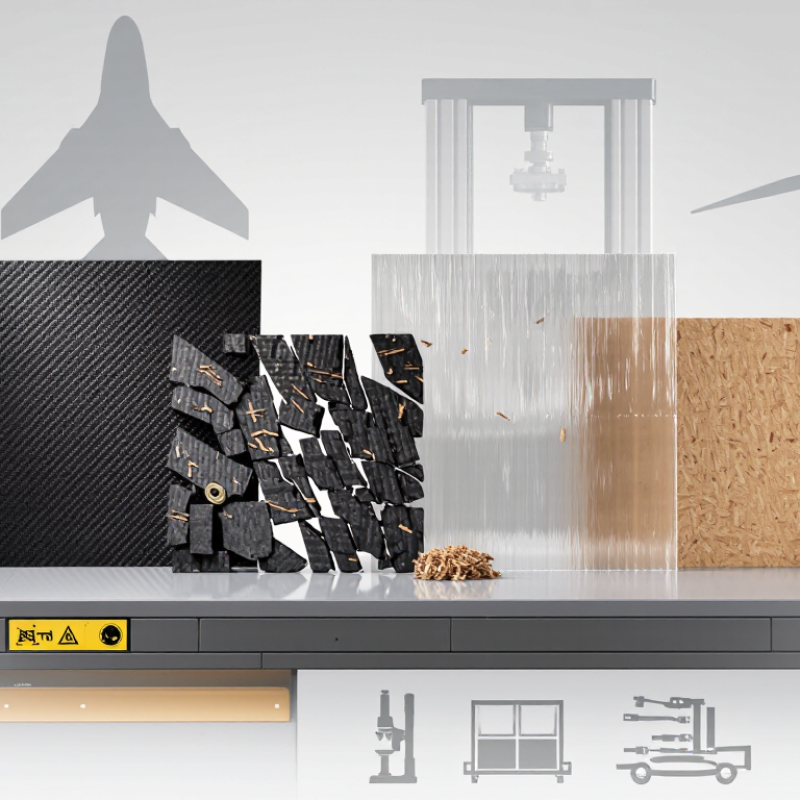
What Are the Best Carbon Composite Materials in 2026?
Carbon composite materials combine carbon reinforcement with a surrounding matrix. Carbon fibers provide stiffness, strength, and low weight. The matrix holds the fibers in position and transfers loads between them. Most products use polymer matrices, while ceramic and metal matrices serve hotter or more demanding environments.
Materials are classified in several practical ways. By reinforcement, they may use continuous fibers, chopped fibers, fabrics, or carbon particles. By matrix, they may be carbon fiber polymer composites, carbon-carbon composites, ceramic-matrix composites, or metal-matrix composites. Fiber direction also matters. Unidirectional laminates resist loads along one axis, while woven fabrics offer more balanced performance. In real testing, moisture, impact damage, temperature, and manufacturing quality can change the result. A neat classification can still mislead.
Tips: Match the material to the load, temperature, and repair conditions. Check verified test data, fiber orientation, resin content, and thickness. Inspect sample panels for voids, uneven surfaces, or dry fibers. These small defects may become serious under repeated stress. The “best” material is application-specific, not automatically the strongest option. My own preference would be conservative selection, although that can increase cost and weight. Evaluate actual service conditions before choosing a carbon composite for 2026 projects.
| Material Class | Matrix or Binder | Carbon Reinforcement | Typical Density | Typical Tensile Strength | Typical Tensile Modulus | Temperature Capability | Key Advantages | Main Limitations | Representative Applications |
|---|---|---|---|---|---|---|---|---|---|
| Carbon-Fiber Reinforced Epoxy | Thermoset epoxy resin | Continuous or woven PAN-based carbon fiber | 1.45–1.65 g/cm³ | 600–1,500 MPa | 50–150 GPa | Approx. −50 to 120–180°C | Excellent specific strength and stiffness; mature processing methods; good dimensional stability; broad design flexibility. | Limited recyclability; moisture and impact performance depend on the resin system; properties are strongly directional. | Aircraft structures, pressure vessels, wind-turbine components, sporting goods, automotive structures, and civil reinforcement. |
| Carbon-Fiber Reinforced Thermoplastic | PEEK, PEKK, PPS, or other high-performance thermoplastic | Continuous, chopped, or short carbon fiber | 1.35–1.65 g/cm³ | 250–1,200 MPa | 20–140 GPa | Approx. 100–260°C, depending on polymer | Fast forming and welding potential; improved toughness; remeltable matrix; better repair and recycling options than most thermosets. | Higher processing temperatures; fiber impregnation can be difficult; material and tooling costs may be high. | Aircraft interiors and brackets, automotive parts, industrial equipment, electrical components, and high-performance consumer products. |
| Carbon-Fiber Reinforced Nylon or Other Engineering Thermoplastic | Polyamide, polycarbonate, or similar engineering polymer | Short or chopped carbon fiber, commonly 10–40% by weight | 1.15–1.45 g/cm³ | 80–300 MPa | 8–35 GPa | Approx. 80–150°C | Good stiffness-to-weight ratio; suitable for injection molding and additive manufacturing; reduced shrinkage and improved dimensional stability. | Lower structural performance than continuous-fiber laminates; anisotropy and weld-line effects can be significant; moisture may affect nylon. | Lightweight housings, brackets, tooling, robot components, fixtures, and low-to-medium load structural parts. |
| Carbon-Fiber Reinforced Aluminum | Aluminum alloy matrix | Continuous carbon fibers or carbon-fiber preforms | 2.0–2.6 g/cm³ | 300–1,000 MPa | 80–220 GPa | Approx. 200–450°C, design-dependent | Higher temperature capability than polymer composites; low thermal expansion in the fiber direction; potential for high specific stiffness. | Carbon and aluminum can form galvanic couples; manufacturing is complex; fiber–matrix reactions and residual stresses require control. | Aerospace panels, satellite structures, precision instruments, automotive components, and thermal-management structures. |
| Carbon-Fiber Reinforced Titanium | Titanium alloy matrix | Continuous carbon fiber or carbon-fiber reinforcement | 3.5–4.5 g/cm³ | 500–1,500 MPa | 120–250 GPa | Approx. 400–700°C, depending on interface design | High specific strength; better high-temperature capability than polymer-matrix composites; strong corrosion resistance from the titanium matrix. | Very high processing cost; carbon–titanium reactions can damage the fiber; joining and interface control are challenging. | Advanced aerospace structures, propulsion components, high-temperature brackets, and specialized defense systems. |
| Carbon–Carbon Composite | Carbon matrix produced by carbonization and densification | Carbon or graphite fibers, usually continuous or woven | 1.5–2.0 g/cm³ | 80–300 MPa | 20–100 GPa | More than 2,000°C in inert or vacuum environments | Exceptional high-temperature capability; low density; good thermal-shock resistance; properties can be tailored through fiber architecture. | Oxidizes rapidly in air at elevated temperature unless protected; expensive and time-consuming densification; relatively brittle. | High-temperature brake components, furnace fixtures, rocket and spacecraft components, and thermal shields. |
| Carbon–Silicon Carbide Composite | Silicon carbide matrix formed by infiltration or reaction processes | Carbon fibers or carbon-fiber preforms | 1.8–2.5 g/cm³ | 100–400 MPa | 30–180 GPa | Approx. 1,000–1,600°C in oxidizing service, depending on coating and design | Lower density than many metal superalloys; high specific stiffness; improved oxidation resistance compared with unprotected carbon–carbon. | Brittle ceramic matrix; thermal-expansion mismatch must be managed; protective coatings may be required for long-term oxidation resistance. | Brake discs, high-temperature aerospace components, heat shields, furnace hardware, and energy-sector components. |
| Carbon-Fiber Reinforced Ceramic | Silicon carbide, carbon, oxide, or other ceramic matrix | Continuous, woven, or chopped carbon fiber | 1.8–3.0 g/cm³ | 100–500 MPa | 30–250 GPa | Approx. 800–1,600°C, material-dependent | High-temperature stability; improved damage tolerance over monolithic ceramics; low density and strong thermal-shock performance in selected designs. | Complex manufacturing; oxidation and interface degradation can occur; machining and inspection are difficult. | Friction systems, thermal-protection parts, combustion hardware, furnace components, and aerospace structures. |
| Carbon Nanotube or Graphene-Modified Polymer Composite | Epoxy, thermoplastic, rubber, or other polymer matrix | Carbon nanotubes, graphene, or hybrid nano-carbon fillers | Approx. 1.0–1.5 g/cm³ | Typically 50–250 MPa for bulk systems | Typically 3–20 GPa for bulk systems | Usually governed by the polymer matrix | Electrical and thermal conductivity enhancement; improved sensing, electromagnetic shielding, and crack-monitoring potential. | Uniform dispersion is difficult; performance depends strongly on interfaces and filler content; large-scale structural strength gains are not automatic. | Conductive coatings, sensors, antistatic components, electromagnetic shielding, batteries, and multifunctional structures. |
Note: Property ranges are typical engineering values rather than guaranteed specifications. Actual performance depends on fiber grade, fiber volume fraction, orientation, weave, porosity, processing method, temperature, moisture, and test standard.
PAN-based carbon fiber with epoxy resin remains a leading option. It offers high tensile strength and stiffness. Applications include aircraft interiors, electric vehicle frames, pressure vessels, and wind turbine parts.
They support faster forming and shorter molding cycles. They can also be reshaped and repaired more easily. This suits electric mobility and higher-volume structural production.
Recycled fiber can serve in brackets, seat structures, tool panels, and industrial housings. Its performance may vary after processing. It is not always suitable for highly demanding structures.
They maintain valuable performance at very high temperatures. Typical uses include aerospace braking systems and thermal protection components. Their cost remains a serious limitation.
Carbon reinforcement can reduce blade deflection and improve fatigue resistance. Larger blades may benefit most from this support. Manufacturing cost and recycling remain difficult concerns.
Autoclave curing creates dense laminates with few voids, but it uses substantial energy. Out-of-autoclave processing reduces equipment needs. Compression molding supports larger production runs and shorter cycles.
Testing should include impact, moisture, heat, ultraviolet exposure, and cyclic fatigue. Temperature changes can weaken a panel over time. Small defects matter.
No. Recycled fibers can reduce resource use but may have shorter lengths and lower strength. Bio-based resins are promising, yet renewable feedstocks can still create emissions. A full life-cycle assessment is needed.
This article explains what a Carbon Composite Material is, how carbon fibers are combined with different matrix systems, and how these materials are classified by fiber structure, resin type, and performance characteristics. It compares key factors such as strength-to-weight ratio, stiffness, fatigue resistance, thermal stability, impact tolerance, cost, and processability. The discussion also examines leading material categories, including carbon fiber-reinforced polymers, thermoplastic carbon composites, hybrid laminates, and carbon-carbon systems, along with their potential applications in transportation, renewable energy, construction, sports equipment, and advanced industrial products in 2026.
The article further reviews manufacturing methods such as automated layup, compression molding, resin transfer processes, filament winding, and additive techniques. It considers durability, repairability, recycling challenges, energy consumption, and responsible material selection. Finally, it provides a practical framework for choosing the best carbon composite for each industry by balancing technical requirements, operating conditions, production volume, lifecycle cost, environmental goals, and regulatory expectations.

 Best Composite