Choosing carbon fiber for global sourcing requires more than comparing prices or tensile strength. The right material must match the product, manufacturing process, and supply risk. A bicycle frame, pressure vessel, and aircraft interior need different performance profiles. Carbon Fiber Carbon Fiber is not a single, universal grade.
Experienced sourcing teams examine fiber type, tow size, modulus, tensile strength, weave, resin compatibility, and surface sizing. They also check batch consistency and storage conditions. A roll may look perfect under warehouse lighting, yet moisture or poor packaging can affect processing. Small details matter.
Reliable suppliers provide technical datasheets, certificates, inspection records, and traceability from fiber to finished roll. Independent laboratory testing can confirm key claims. However, documents are not always complete, and early assumptions may be wrong. A sample trial often reveals handling problems that specifications cannot show. It is worth testing cutting, draping, curing, and surface finish before committing to volume.
Global sourcing adds practical concerns. Lead times, customs documentation, packaging strength, payment terms, and supplier communication can influence the final cost. A lower quote may hide rework, delays, or inconsistent quality. Responsible buyers should compare total landed cost, not only the unit price. They should also verify ethical business practices and applicable trade requirements.
This guide explains how to evaluate carbon fiber with evidence and commercial realism. It connects laboratory data with factory experience. The goal is not to find the strongest material. It is to find the most dependable material for the intended application, budget, and production environment. Mistakes still happen. Careful validation makes them less expensive.
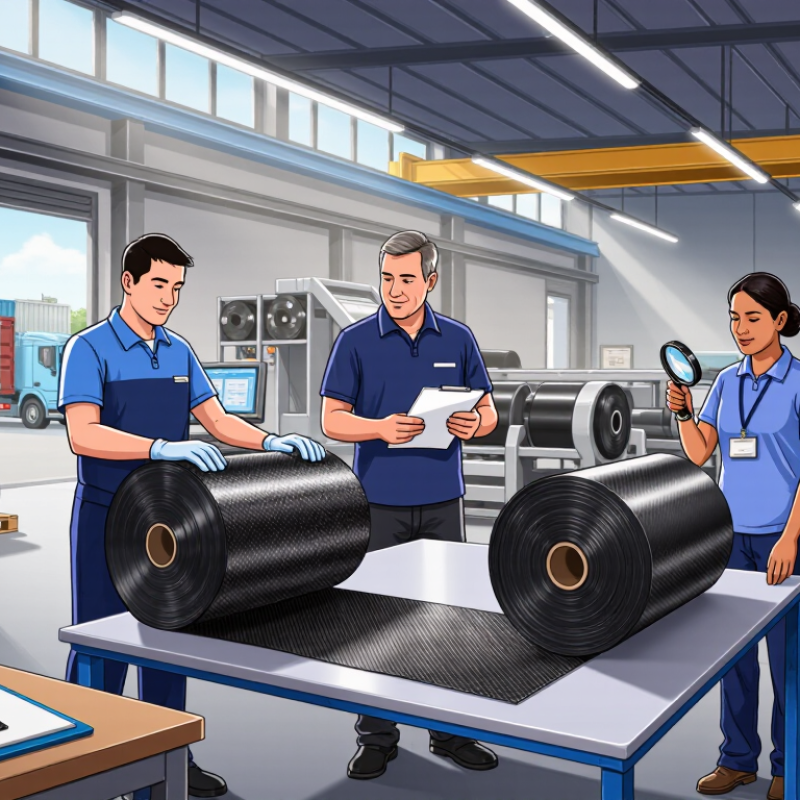
How to Choose Carbon Fiber for Global Sourcing?
Carbon fiber is not one universal material. Its performance depends on precursor, tow size, surface treatment, and processing route. Most commercial fibers have densities near 1.75–2.00 g/cm³, according to U.S. Department of Energy materials guidance. Typical tensile strength ranges from 3 to 7 GPa. Tensile modulus may reach 500 GPa in high-modulus grades. These figures look impressive. They do not guarantee a strong finished component.
For global sourcing, examine the full specification, not only the fiber grade. A 12K tow contains roughly 12,000 filaments, while a 3K tow supports finer fabrics and more detailed shapes. Unidirectional tape offers excellent strength along one axis. Woven fabric improves handling and balanced loading. Resin compatibility also matters. Poor wet-out can leave dry zones, voids, and uneven stiffness. I have seen attractive test coupons fail after inconsistent curing. That risk is easy to underestimate.
The International Energy Agency reported more than 14 million electric cars sold globally in 2023. Lightweight structures therefore face growing demand, but price pressure remains severe. Ask suppliers for batch-level tensile data, coefficient of variation, sizing content, and moisture controls. Require testing under standards such as ISO 10618 and ASTM D3039. Compare delivered cost, not quotation price. Freight, packaging, inspection, and rejected lots can change the decision. A lower-cost fiber may become expensive after production delays. Supplier claims still need independent verification.
When choosing carbon fiber for global sourcing, start with the part’s real working conditions. A bicycle frame, pressure vessel, and robotic arm require different fiber architectures. Record load direction, operating temperature, moisture, impact exposure, and expected service life. Do not begin with a grade number. Begin with failure risks.
Translate the application into measurable material requirements. Specify tensile strength, elastic modulus, elongation, fiber volume, tow size, and surface treatment. Define whether the part needs woven fabric, unidirectional tape, or chopped fiber. The resin system also matters. It must match the curing process, production speed, and environmental exposure. Small details matter. A high-modulus fiber may reduce deflection, but it can increase brittleness and processing cost. A lower-cost option may perform better under repeated impact.
For global sourcing, request samples from more than one qualified supplier. Compare batch test reports, dimensional tolerances, moisture protection, labeling, and traceability records. Confirm that documentation supports your destination market and internal quality procedures. In practice, teams often over-specify tensile strength while overlooking resin compatibility. That mistake can raise costs without improving the finished part. Test a representative laminate before approving volume orders. Include temperature cycling, fatigue, and impact checks when relevant. A requirement sheet should clearly separate mandatory properties from negotiable ones. It should also admit uncertainty. Your first specification may be wrong. Revise it after testing real material in the actual design.
How to Choose Carbon Fiber for Global Sourcing?
Carbon fiber selection starts with grade, not price. Standard-modulus fiber usually provides about 230 GPa tensile modulus. Intermediate-modulus grades approach 290 GPa. High-modulus options can exceed 390 GPa, but they often sacrifice strain tolerance and raise processing costs. Supplier values differ, so verify them through ASTM D3039 or ISO 527 testing.
Form matters just as much. Continuous tow suits filament winding and pultrusion. Woven fabric offers better handling around corners, though it may reduce fiber alignment. Chopped fiber works well in compression molding and compound materials. Prepreg delivers accurate resin content, but refrigerated storage can complicate global logistics. Dry fabric combined with resin transfer molding may reduce storage pressure. It also demands stricter mold and infusion control.
Manufacturing method changes the purchasing decision. Autoclave processing supports high consolidation quality, while out-of-autoclave systems can lower equipment costs. Automated fiber placement improves repeatability for large panels. The choice should match part volume, geometry, labor skills, and inspection capacity. CompositesWorld’s 2024 carbon-fiber capacity reporting placed global nameplate capacity above 200,000 metric tonnes annually. Meanwhile, the International Energy Agency reported over 17 million electric-car sales in 2024, strengthening demand for lightweight structures. That demand does not justify buying the stiffest grade. A glossy datasheet can hide poor impact performance. I would request lot-level certificates, tow sizing details, void data, and trial laminates. One mistake remains common: selecting fiber first, then forcing the process to fit.
| Carbon Fiber Category | Typical Grade Characteristics | Typical Tensile Strength | Typical Tensile Modulus | Common Product Forms | Preferred Manufacturing Methods | Typical Applications | Sourcing Considerations |
|---|---|---|---|---|---|---|---|
| Standard-Modulus Carbon Fiber | Balanced performance, broad availability, and generally the most economical carbon-fiber option. | Approximately 3.5–5.0 GPa | Approximately 220–250 GPa | Continuous tow, woven fabric, unidirectional tape, prepreg, chopped fiber, and carbon-fiber-reinforced compound. | Filament winding, pultrusion, compression molding, autoclave molding, resin transfer molding, and automated tape placement. | Automotive structures, industrial components, sporting goods, pressure vessels, and general lightweight structures. | Good starting point for cost-sensitive programs; verify tow size, sizing compatibility, and lot-to-lot consistency. |
| Intermediate-Modulus Carbon Fiber | Higher stiffness than standard-modulus fiber while maintaining useful strength and damage tolerance. | Approximately 4.5–6.0 GPa | Approximately 280–330 GPa | Continuous tow, unidirectional tape, woven fabric, and prepreg. | Autoclave molding, out-of-autoclave prepreg processing, filament winding, pultrusion, and automated fiber placement. | Aerospace structures, robotics, high-performance transportation, and precision industrial equipment. | Use when stiffness, weight reduction, and dimensional stability justify a higher material cost. |
| High-Modulus Carbon Fiber | Very high stiffness with lower strain-to-failure than standard and intermediate grades; requires careful design against impact and handling damage. | Approximately 2.5–4.0 GPa | Approximately 350–อย่าง440 GPa | Continuous tow, unidirectional tape, woven fabric, and specialized prepreg. | Autoclave molding, automated fiber placement, precision prepreg lay-up, and selected filament-winding processes. | Satellite components, precision aerospace parts, high-stiffness booms, optical benches, and high-end sporting equipment. | Specify allowable strain, impact requirements, and handling controls; maximum modulus is not always the best overall choice. |
| High-Strength Carbon Fiber | Strength-focused grade designed for high tensile loads and improved structural load capacity. | Approximately 4.5–7.0 GPa | Approximately 230–300 GPa | Continuous tow, woven fabric, unidirectional tape, prepreg, and chopped fiber. | Filament winding, pultrusion, resin transfer molding, compression molding, and prepreg processing. | Pressure vessels, automotive safety structures, wind-energy components, lifting equipment, and primary load-bearing parts. | Confirm tensile, compression, interlaminar, and fatigue performance at the laminate level rather than relying only on fiber data. |
| Pitch-Based Carbon Fiber | Often selected for very high thermal conductivity or modulus; properties depend strongly on precursor and heat-treatment level. | Grade-dependent; often approximately 1.5–4.0 GPa | Grade-dependent; approximately 150–900 GPa | Continuous tow, fabric, felt, paper, and chopped fiber. | Compression molding, lay-up, hot pressing, resin impregnation, and specialized thermal-management processing. | Thermal spreaders, furnace components, friction materials, electromagnetic applications, and precision structural parts. | Prioritize thermal conductivity, coefficient of thermal expansion, and processing compatibility over tensile strength alone. |
| PAN-Based Carbon Fiber | The dominant precursor family, offering a broad range of strength, modulus, surface treatment, and commercial forms. | Approximately 3.5–7.0 GPa, depending on grade | Approximately 220–440 GPa, depending on grade | Continuous tow, fabric, tape, prepreg, chopped fiber, milled fiber, and recycled fiber. | Suitable for most composite processes, including winding, pultrusion, infusion, compression molding, and autoclave molding. | General-purpose composites, mobility, aerospace, energy, construction reinforcement, and consumer products. | Usually offers the broadest global supply base; compare sizing, tow count, surface treatment, and certification documentation. |
| Continuous Tow | Unbroken bundles of carbon filaments supplied by filament count, commonly identified by tow size. | Depends on fiber grade and tow size | Depends on fiber grade | 3K, 6K, 12K, 24K, and larger tow formats are common; exact availability varies by supplier and grade. | Filament winding, braiding, pultrusion, weaving, automated fiber placement, and tape production. | Pressure vessels, tubes, beams, aerospace components, and woven or braided preforms. | Check filament count, linear density, twist, sizing percentage, spool format, and production continuity. |
| Woven Fabric | Interlaced carbon-fiber yarns that provide convenient handling and multi-directional reinforcement. | Laminate-dependent; commonly lower than aligned UD in the primary fiber direction | Laminate-dependent; influenced by weave architecture | Plain, twill, satin, and hybrid constructions; supplied dry or pre-impregnated with resin. | Hand lay-up, vacuum infusion, resin transfer molding, compression molding, and autoclave processing. | Panels, covers, sporting goods, marine components, vehicle body parts, and repair laminates. | Compare areal weight, weave style, crimp, drape, resin content, roll width, and visual surface requirements. |
| Unidirectional Tape | Most fibers are aligned in one direction, enabling efficient load transfer along the main design axis. | High in the fiber direction; laminate-dependent | High in the fiber direction; laminate-dependent | Dry tape, thermoset prepreg, thermoplastic tape, and slit tape. | Automated tape placement, automated fiber placement, pultrusion, compression molding, and controlled lay-up. | Beams, spars, pressure vessels, wind-turbine components, and highly optimized structural laminates. | Best for directional loads; review steering limits, tack, drape, backing film, storage temperature, and out-time. |
| Chopped or Milled Fiber | Short carbon fibers used to improve stiffness, conductivity, dimensional stability, or reinforcement in molded compounds. | Not directly comparable with continuous-fiber laminate values | Not directly comparable with continuous-fiber laminate values | Chopped strands, milled powder-like fiber, pellets, and premixed compounds. | Injection molding, compression molding, sheet molding compound, bulk molding compound, and additive manufacturing. | Electrical housings, brackets, tooling, friction materials, conductive components, and complex molded parts. | Specify fiber length distribution, loading percentage, dispersion, compound viscosity, and surface-finish targets. |
| Dry Fiber Reinforcement | Carbon fiber supplied without cured matrix resin, allowing the fabricator to select the resin system and infusion process. | Final performance depends on fiber grade, architecture, and cured laminate | Final performance depends on fiber grade, architecture, and cured laminate | Dry fabric, stitched multiaxial fabric, braid, non-crimp fabric, and dry unidirectional tape. | Vacuum infusion, resin transfer molding, resin film infusion, and liquid composite molding. | Large structures, marine parts, wind-energy components, automotive parts, and repair work. | Compare permeability, preform stability, binder content, nesting behavior, resin compatibility, and storage conditions. |
| Prepreg | Carbon fiber pre-impregnated with a controlled amount of partially cured resin for consistent fiber-resin ratios. | Laminate-dependent; typically high when properly consolidated | Laminate-dependent; typically high when properly consolidated | Unidirectional tape, woven prepreg, multiaxial prepreg, and thermoplastic composite tape. | Autoclave molding, hot-press molding, compression molding, oven curing, and automated placement. | Aerospace parts, motorsport components, sporting goods, medical equipment, and precision structures. | Review resin cure cycle, freezer life, out-life, volatile content, tack, drape, minimum order quantity, and cold-chain logistics. |
| Filament Winding | Continuous tow is placed under controlled tension and angle around a mandrel. | Highly dependent on winding angle and consolidation | Highly dependent on winding angle and consolidation | Continuous tow, wet winding material, and prepreg tow. | Wet winding, dry winding with later resin injection, and prepreg winding. | Compressed-gas cylinders, pipes, drive shafts, pressure vessels, and cylindrical structures. | Control fiber tension, winding angle, resin content, cure shrinkage, liner compatibility, and nondestructive testing requirements. |
| Pultrusion | Continuous fibers are pulled through resin impregnation and heated shaping dies to create constant cross-sections. | High longitudinal strength; transverse performance is lower | High longitudinal stiffness; architecture-dependent | Continuous tow, unidirectional roving, stitched fabric, and hybrid reinforcement. | Thermoset pultrusion and thermoplastic pultrusion. | Profiles, rods, beams, cable trays, tool handles, and structural reinforcement. | Best for constant profiles; check die compatibility, production speed, surface quality, straightness, and cut-length tolerance. |
| Resin Transfer Molding and Infusion | Dry reinforcement is placed in a mold and impregnated with liquid resin under pressure or vacuum. | Laminate-dependent; often lower fiber-direction efficiency than well-consolidated prepreg | Laminate-dependent | Dry fabric, non-crimp fabric, stitched preform, braid, and dry tape. | Vacuum infusion, light resin transfer molding, and high-pressure resin transfer molding. | Automotive panels, marine structures, wind-energy parts, aircraft interiors, and large composite components. | Evaluate resin viscosity, infusion time, permeability, void content, mold size, preform handling, and cure temperature. |
| Compression Molding | Reinforcement and resin are consolidated in a heated matched mold using pressure and controlled cycle time. | Depends on compound, fiber length, orientation, and molding conditions | Depends on compound, fiber length, orientation, and molding conditions | Prepreg charge, sheet molding compound, bulk molding compound, and thermoplastic organosheet. | Hot compression molding, stamp forming, and matched-die molding. | Automotive parts, brackets, housings, structural panels, and high-volume molded components. | Compare cycle time, charge design, flow behavior, fiber orientation, mold temperature, and dimensional repeatability. |
| Autoclave and Oven Curing | Controlled heat and, in autoclave processing, external pressure are used to consolidate and cure prepreg laminates. | Often high due to controlled consolidation and low void content | Often high due to controlled consolidation and low void content | Thermoset prepreg, adhesive film, honeycomb sandwich materials, and high-performance lay-ups. | Autoclave cure, vacuum-bag oven cure, and pressurized oven cure. | Aerospace structures, motorsport components, high-end sporting goods, and low-volume precision parts. | Account for equipment size, energy use, cure-cycle duration, freezer logistics, tooling, and operator qualification. |
Note: Property ranges are representative industry ranges for carbon-fiber grades and are not guaranteed specifications. Actual performance depends on precursor, heat treatment, sizing, tow size, fiber volume fraction, resin system, laminate architecture, consolidation quality, and test method. Always request current technical data sheets, certificates of analysis, and laminate-level test data before commercial qualification.
Choosing carbon fiber for global sourcing requires more than comparing prices. Start by evaluating the supplier’s production experience, material traceability, and quality control records. Ask how fibers, resins, and fabrics are stored before processing. A reliable supplier should provide batch numbers, technical data sheets, and inspection reports for each shipment.
Quality standards must match the intended application. Check tensile strength, modulus, fiber volume, surface finish, and dimensional stability. Request samples from several production lots, not only one approved piece. Independent laboratory testing can verify the supplier’s claims. Certifications such as ISO 9001 support process consistency, while ISO 14001 may indicate structured environmental management. For aerospace, medical, or automotive projects, confirm the certifications required by your industry and destination market.
Do not treat certificates as proof of perfect performance. They show controlled systems, not flawless products. During supplier audits, inspect calibration records, nonconformance procedures, and worker training. Review how defects are isolated and corrected. Clear communication matters too. Can the supplier explain a test failure without hiding details? Can it maintain the same specification across borders and production cycles? I once saw a visually clean panel fail after humidity exposure. The lesson was uncomfortable: appearance is only one piece of evidence. A strong sourcing decision combines documents, testing, factory experience, and honest risk review.
Price per kilogram is only the visible line. Oak Ridge National Laboratory assessments place conventional PAN-based carbon fiber near $5–$15 per pound, depending on grade and volume. Treat that range as a screening benchmark, not a quotation. Your worksheet should add conversion, spools, export packing, inland pickup, ocean or air freight, insurance, duties, inspection, financing, and scrap. Freight changes quickly. A low material price can become expensive after one urgent shipment.
The World Bank’s 2023 Logistics Performance Index evaluates customs, infrastructure, shipment quality, and timeliness across 139 economies. Use its findings when comparing supplier locations, but do not trust rankings alone. Request carton dimensions, gross weight, reel count, HS classification, and moisture-protection details before comparing offers. Carbon fiber is light, but cartons consume volume and handling space. Model normal freight beside a disruption case, including 30 days of extra inventory.
Technical risk deserves a monetary value. Check lot certificates, tensile data, sizing compatibility, and change-notification rules. For prepreg, include freezer storage, temperature monitoring, and shelf-life losses. For dry tow, verify filament count and winding consistency. The U.S. Department of Energy’s carbon-fiber manufacturing reports identify process yield and precursor quality as important cost drivers. I would still challenge my own spreadsheet. It often underprices rejected lots, qualification time, and engineer travel. No model is perfect.
Start with the part’s working conditions, not a grade number. Record load direction, temperature, moisture, impacts, and service life. Begin with failure risks.
Specify tensile strength, modulus, elongation, fiber volume, tow size, and surface treatment. Separate mandatory properties from negotiable ones. Leave room for revision.
Continuous tow suits filament winding and pultrusion. Woven fabric handles corners better but may reduce fiber alignment. Chopped fiber fits compression molding. Prepreg offers controlled resin content, but storage can be difficult.
The resin must match curing temperature, production speed, and environmental exposure. A strong fiber can still fail in an unsuitable resin system. This detail is often overlooked.
No. High-modulus fiber can reduce deflection but increase brittleness and cost. Lower-cost fiber may perform better during repeated impacts. Stiffness is not everything.
Request samples from several qualified suppliers. Compare batch reports, dimensional tolerances, moisture protection, labels, and traceability records. Review documentation for your destination market.
Match the material to part volume, geometry, labor skills, and inspection capacity. Autoclaves can improve consolidation quality. Out-of-autoclave methods may reduce equipment costs. Do not force the process to fit the fiber.
Test a representative laminate in the actual design. Include temperature cycling, fatigue, and impact checks when relevant. Inspect voids and resin distribution. The first specification may be wrong.
Choosing carbon fiber for global sourcing begins with understanding its core properties, including strength-to-weight ratio, stiffness, fatigue resistance, temperature performance, and corrosion resistance. Buyers should first define the application, operating environment, load requirements, design life, and processing method. These factors help determine the most suitable grade, fiber orientation, form, and manufacturing approach, whether for woven materials, unidirectional fabrics, prepreg, molded components, or other engineered solutions. Carbon Fiber Carbon Fiber selection should always be based on technical needs rather than price alone.
A reliable sourcing strategy also requires careful supplier evaluation. Review production capacity, quality control systems, testing methods, traceability, and relevant certifications. Compare quotations by calculating total cost, including material prices, tooling, processing, packaging, transportation, duties, inspection, and inventory requirements. Buyers should also assess lead times, communication, supply continuity, geographic risks, and contingency plans. By balancing performance, quality assurance, logistics, and total landed cost, companies can make more informed sourcing decisions and build a stable, efficient, and responsible global supply chain.

Best Composite