Choosing the right Random Copolymer Pp Resin can determine whether a product feels clear, survives impact, and runs smoothly on the production line. The decision is rarely based on price alone. Melt flow rate, ethylene content, stiffness, transparency, odor, and processing stability all deserve careful attention. A resin that performs well in thin packaging may fail in a rigid container.
Dr. John M. Dealy, a respected polymer rheologist, described polymer processing as “both an art and a science.” That idea fits Random Copolymer Pp Resin selection closely. Laboratory data provides direction, but actual machine behavior reveals important details. Watch the extruder pressure, cooling pattern, surface gloss, and cycle consistency. Small changes can become visible defects, especially around corners, weld lines, or thin sections.
This guide presents seven practical tips for comparing grades with greater confidence. It considers application requirements, melt flow, impact performance, clarity, additive packages, supplier documentation, and production trials. Technical datasheets matter, but they never tell the whole story. A resin may meet every listed specification and still create warpage or unstable feeding. That uncomfortable possibility deserves attention.
The best choice is usually the grade that balances performance, cost, and processing tolerance. Not the most expensive option. Not always the one with the highest stiffness. Careful testing remains essential, even when the supplier has an impressive reputation. A small pilot run, measured under real processing conditions, can prevent a much larger mistake.
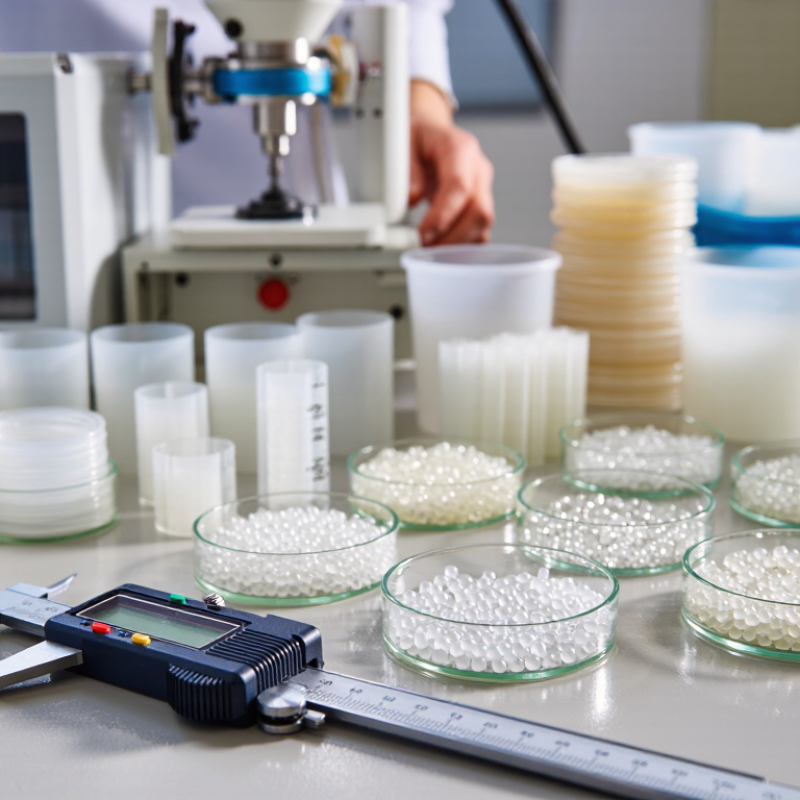
Random copolymer polypropylene resin is made by polymerizing propylene with a small amount of comonomer, often ethylene, distributed through the chain. This structure reduces crystallinity and creates a softer, clearer material than standard homopolymer polypropylene. It is commonly selected for transparent containers, thin-wall packaging, laboratory items, and flexible molded parts.
Its key properties include good optical clarity, smooth surfaces, low density, and useful impact resistance at room temperature. It also offers strong chemical resistance against many water-based solutions. However, clarity can decrease after poor processing or excessive cooling variation. Heat resistance and stiffness are usually lower than those of homopolymer grades, so the intended service temperature matters.
When choosing a grade, check melt flow rate against the molding method and wall thickness. A higher flow grade can fill narrow sections, but it may reduce toughness in some designs. Review impact data, haze, gloss, sealing behavior, odor, and regulatory documentation. Processing teams should also examine shrinkage and cycle stability through small production trials.
I once focused too heavily on transparency and overlooked drop performance. That choice required a later adjustment. A practical evaluation should compare real parts, not only data sheets. Ask for test conditions, because impact results can change with temperature, specimen shape, and conditioning time. Always confirm food-contact or other application requirements with current technical documents.
Random copolymer polypropylene resin is commonly selected for its balance of clarity, impact resistance, processability, stiffness, and heat performance. The chart shows representative midpoint values from commonly published technical ranges for non-branded random copolymer PP grades.
Selection tips: Check the required melt flow rate for processing, compare density and stiffness, evaluate clarity or haze requirements, confirm impact performance at the expected temperature, review melting-point limits, match the resin to injection molding or extrusion conditions, and verify compliance with the intended application standards.
Random copolymer PP resin should be selected for the product’s real working conditions, not only its price or appearance. A transparent container may need good clarity, impact resistance, and stable molding behavior. A thin wall can crack during filling, stacking, or transport if the resin lacks toughness.
For food containers, check odor, extractables, sealing performance, and applicable contact requirements. For household parts, stiffness and resistance to repeated impact may matter more. Medical packaging may require controlled cleanliness and documented production quality. Melt flow rate also deserves attention. A higher value can support fast filling, but excessive flow may reduce strength or create uneven walls.
In production trials, I compare the resin with the actual mold, wall thickness, cycle time, and cooling conditions. Laboratory data helps, but it never tells the whole story. A resin that performs well in a small test piece may behave differently in a large container. I once focused too heavily on clarity and overlooked drop resistance. That was a useful mistake. Check the technical data sheet, then confirm results through impact, haze, dimensional, and sealing tests. Keep records from several batches, because one successful run does not prove long-term consistency.
When selecting random copolymer PP resin, clarity should match the product’s real visual demands.
A clear sample in a laboratory cup may look different after injection molding. Flow rate, wall thickness, mold temperature, and cooling conditions can change haze and gloss. I usually compare plaques at identical thickness, then inspect them under daylight and angled LED light. Tiny streaks matter. Do not trust one certificate. Ask for haze, transparency, and lot-to-lot variation data measured by recognized methods.
Impact strength needs a temperature context.
A resin that survives a room-temperature drop may crack in a cold warehouse. Test molded parts after conditioning them at expected service temperatures. Use a repeatable drop or instrumented impact test, and record the fracture appearance. Brittle, star-shaped cracks deserve attention. Processing history also matters. Excessive shear and poor weld-line design can weaken the part. I have seen a resin pass a flat plaque test yet fail around a sharp corner. That exposed a weakness in the test plan.
Flexibility is not simply softness.
Check flexural modulus, hinge performance, and recovery after repeated bending. A thin lid may need easy movement, while a rigid container needs shape retention. Mold several samples, bend them repeatedly, and measure whitening or permanent deformation. Compare results across production lots. Data can drift. Small trial runs often reveal more than attractive datasheets.
When choosing random copolymer PP resin, match the grade to the actual processing conditions. Do not rely only on melt flow rate. Review the required melt temperature, mold temperature, injection speed, cooling time, and expected cycle length. A resin designed for thin containers may behave differently in thicker parts. That difference matters.
Check the equipment carefully. Confirm that the screw can deliver stable melting without excessive shear. Inspect the barrel temperature zones, back pressure settings, nozzle design, and die or mold layout. In extrusion, cooling capacity is especially important. Uneven cooling can create warpage, haze, or dimensional variation. In injection molding, poor gate design may cause flow marks or weak weld lines. Small details matter.
I recommend running a controlled trial before approving regular production. Record actual temperatures, pressure, cycle time, and part weight. Compare those results with the resin supplier’s technical data. A clean hopper and dry material path also reduce avoidable problems, even though PP generally absorbs little moisture. This point is often overlooked. It can be costly.
Equipment compatibility is not always obvious from a datasheet. Older screws, worn check rings, or unstable temperature sensors can distort the trial results. I have seen teams blame the resin too quickly. In reality, the machine needed maintenance. Leave room for adjustment, and question results that seem unusually perfect. Real production rarely stays perfect.
| Processing Dimension | Typical Starting Range or Requirement | Why It Matters for Random Copolymer PP | Equipment Compatibility Check | Selection Guidance |
|---|---|---|---|---|
| Melt Processing Temperature | Barrel profile commonly starts around 180–220°C; the exact melt temperature should follow the resin supplier’s technical data. | Insufficient heat can cause poor filling and surface defects, while excessive heat may increase degradation, odor, or discoloration. | Confirm that the barrel, nozzle, hot runner, and temperature-control system can maintain a stable profile within the required range. | Choose a grade whose recommended melt window fits the machine’s heating capacity and process-control accuracy. |
| Mold or Tool Temperature | A typical starting range is approximately 20–60°C, adjusted for part thickness, appearance, cycle time, and dimensional requirements. | Mold temperature affects crystallization, shrinkage, weld-line appearance, gloss, and cycle time. | Check cooling-channel layout, flow rate, temperature-control capacity, and the tool’s ability to maintain uniform cavity temperature. | For high-appearance parts, prioritize uniform cooling and precise temperature control over the lowest possible mold temperature. |
| Drying Requirement | PP generally does not require routine pre-drying because it has low moisture absorption; dry material if it has been exposed to water, condensation, or high humidity. | Moisture is usually a surface-contamination issue rather than an inherent moisture-absorption issue, but wet pellets can cause splay, bubbles, or processing instability. | Verify whether the plant has a hopper dryer, desiccant dryer, or warm-air system available for emergency or moisture-control use. | Select a grade that matches the facility’s material-handling controls and storage conditions; keep pellets sealed and above condensation temperature. |
| Screw Design and L/D Ratio | A general-purpose reciprocating screw with an L/D ratio around 18:1–24:1 is commonly suitable for injection molding; extrusion equipment may use longer screws. | Adequate conveying, melting, and mixing help maintain stable melt temperature and uniform additive distribution. | Check screw geometry, feed-zone design, non-return valve condition, and shot-size utilization. A worn screw can cause inconsistent dosing and cushion. | For standard unfilled random copolymer PP, a general-purpose screw is often appropriate; use a mixing section only when the application requires improved homogenization. |
| Shear and Screw Speed | Use moderate screw speed and back pressure as a starting point, then adjust using melt temperature, recovery time, and part appearance. | Excessive shear can raise melt temperature and contribute to degradation, while insufficient mixing can produce color or additive non-uniformity. | Confirm that the drive motor, hydraulic or electric system, and control software can provide stable low-to-moderate screw speeds. | Prefer a resin that reaches the required output without forcing the machine to operate continuously at its maximum screw speed or pressure. |
| Residence Time and Thermal Stability | Minimize unnecessary residence time; use the resin’s recommended maximum exposure conditions and avoid leaving molten PP in a hot barrel for extended periods. | Long residence time combined with high temperature can cause oxidation, black specks, odor, molecular-weight loss, or color change. | Evaluate barrel capacity, shot size, purge capability, dead spots, hot-runner volume, and shutdown procedures. | For low-volume production, avoid equipment with an excessively large barrel or hot-runner volume relative to the shot size. |
| Mold Filling, Gate, and Venting | Use gate and runner dimensions appropriate for the part thickness and flow length; provide effective vents near end-of-fill areas. | Random copolymer PP can provide good flow, but thin walls, long flow paths, and restricted gates may still cause short shots, burn marks, or weld-line weakness. | Check injection pressure, injection rate, gate type, runner balance, vent depth, and clamp-force capacity. | Choose a grade with a melt-flow range that fills the part without requiring excessive injection pressure or overly aggressive injection speed. |
| Material Handling and Contamination Control | Keep pellets clean, dry from external water exposure, and stored in closed containers; control regrind content according to the application specification. | Dust, foreign polymers, excessive fines, or uncontrolled regrind can affect appearance, odor, impact performance, and process consistency. | Inspect loaders, hoppers, magnets, filters, conveying lines, and blender accuracy. Confirm that the system can handle the pellet size and bulk density. | Select a resin that can be conveyed and metered reliably by the existing material-handling system, especially for high-output production. |
Note: The values shown are general starting ranges for unfilled random copolymer polypropylene. Actual settings depend on melt-flow rate, part geometry, additives, equipment design, mold construction, and the resin supplier’s technical data sheet.
Do not judge random copolymer PP resin by appearance alone. Check melt flow rate, impact strength, stiffness, odor, and ash content against the agreed specification. ISO 1133 defines melt flow testing, while ISO 527 supports tensile-property evaluation. ASTM D256 can help assess notched impact performance. Request recent batch certificates, test methods, and retain samples. In production trials, small flow differences can change filling speed and warpage. That detail is easy to miss.
PlasticsEurope reported 400.3 million tonnes of global plastics production in 2022. Such scale increases the need for traceable quality control. However, a certificate is not the same as stable performance. Compare three or more batches under identical processing conditions. Keep the records. They reveal patterns better than one perfect sample.
Ask about monthly capacity, safety stock, lead time, and backup production sites. S&P Global Commodity Insights has repeatedly highlighted polypropylene’s exposure to feedstock costs, maintenance outages, and regional logistics disruptions. A low quoted price may become expensive after freight, drying, scrap, mold adjustments, and delayed production are added.
Build a simple landed-cost sheet. Include resin price, transport, inspection, inventory, and rejection risk. Review payment terms too. I have seen purchasing teams focus on cents per kilogram and overlook a week of downtime. That mistake is expensive. Still, no supplier can promise perfect continuity. Challenge the assumptions, test the material, and document what remains uncertain.
It is polypropylene combined with a small amount of another monomer. The comonomer spreads through the polymer chain. This lowers crystallinity and creates softer, clearer parts.
It suits transparent containers, thin-wall packaging, laboratory items, and flexible molded parts. It can provide smooth surfaces and useful room-temperature impact resistance. Product needs still matter more than appearance.
Random copolymer grades usually offer better clarity and softness. They often have lower stiffness and heat resistance. Check the intended service temperature carefully.
Higher melt flow can fill narrow sections and thin walls more easily. Excessive flow may reduce toughness or create uneven wall thickness. Test the actual mold.
Review impact strength, haze, gloss, odor, sealing behavior, shrinkage, and cycle stability. Check chemical resistance for the intended liquid. A clear part can still fail during a drop.
Data sheets cannot show every molding condition. Cooling changes can affect clarity, warpage, and dimensions. Compare real parts using the actual mold, wall thickness, and cycle time.Keep the records.
Request recent batch certificates, test methods, agreed specifications, and retain samples. Review melt flow, impact strength, stiffness, odor, and ash content. Compare at least three batches under identical conditions.
Ask about monthly capacity, safety stock, lead time, and backup production locations. Include freight, inspection, inventory, scrap, mold adjustments, and downtime. A lower kilogram price may hide a costly delay.
I once prioritized transparency and overlooked drop performance. The design later needed adjustment. That mistake showed me that appearance cannot replace practical testing. Some assumptions may remain uncertain.
Choosing the right Random Copolymer Pp Resin is essential for producing reliable, attractive, and cost-effective plastic products. Start by matching the resin’s performance with the product’s end use, considering factors such as required strength, temperature resistance, flexibility, and long-term durability. For applications where appearance matters, evaluate clarity and surface quality, while also checking impact strength and flexibility to ensure the finished product can withstand handling and use without cracking.
Processing requirements are equally important. Confirm that the resin is compatible with the available molding equipment, processing temperatures, cycle times, and production methods. In addition, review quality standards, consistency between batches, technical support, and supply stability. A resin with a lower purchase price may not be the most economical choice if it causes processing problems, waste, or inconsistent product quality. By considering performance, appearance, processing compatibility, dependable supply, and total cost together, manufacturers can select a material that supports efficient production and meets the expectations of the final application.
Best Composite